
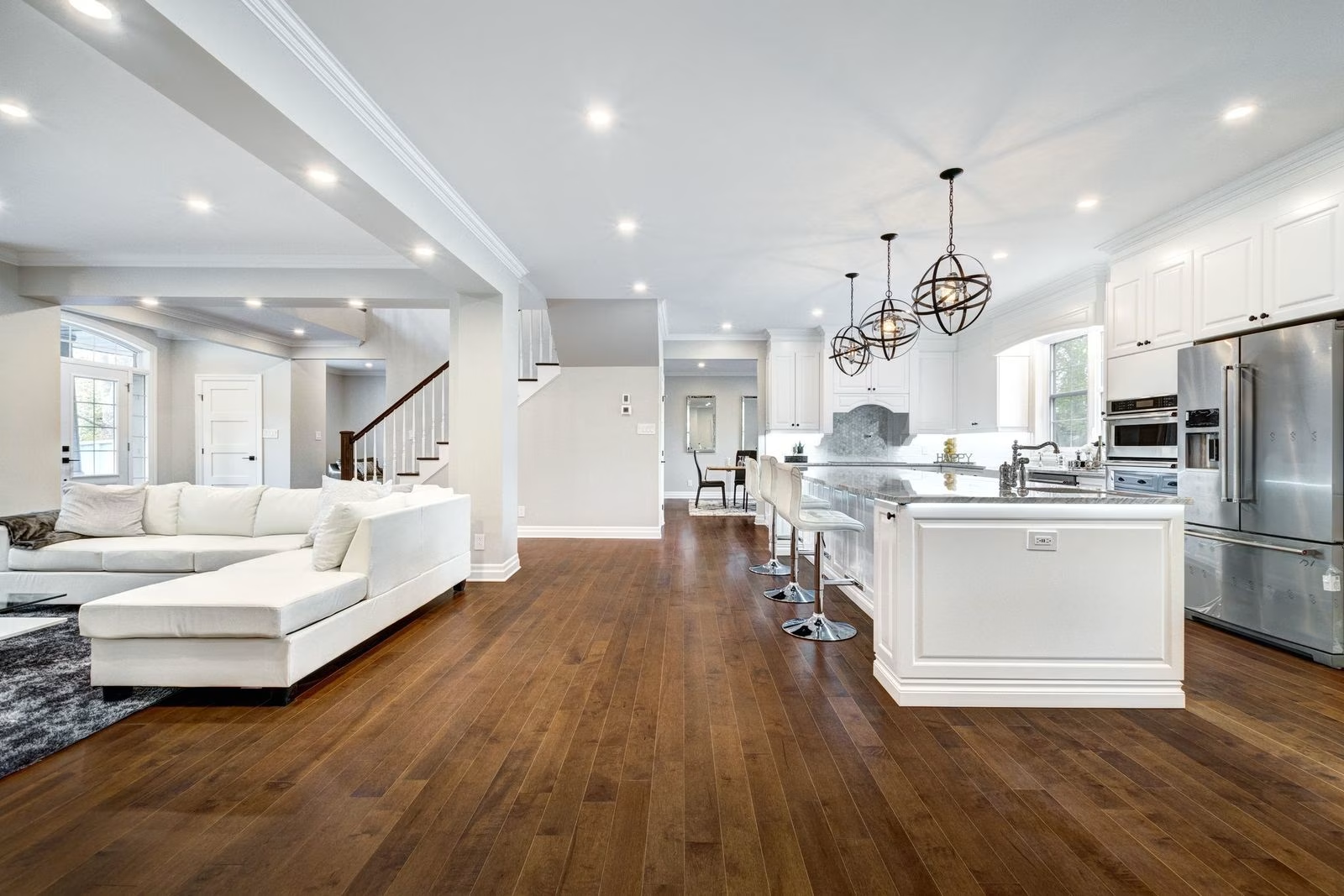
A tile can look right on a sample board without being the right choice for your project.
The bathroom wall, kitchen floor and entrance may share a colour palette, but they do not experience the same use. Water exposure, footwear, cleaning and the surrounding construction all influence what needs to be considered.
Before narrowing the colour or pattern, identify where the tile will go and what you expect from it. Then review the specific product rather than relying only on a label such as “porcelain” or “natural stone.”
For Toronto homeowners, this approach makes selection more focused. It also helps avoid purchasing tile before the installer has assessed how it fits the intended work.
Describe the Location Precisely
“Bathroom tile” is a broad description.
It could mean a decorative wall, the main floor, a bathtub surround or a shower floor. Each location needs its own assessment.
The same applies in a kitchen. A backsplash and a walking surface serve different purposes, even when you want them to coordinate visually.
Write down:
- The room.
- The surface being tiled.
- Whether the area regularly becomes wet.
- How people use it.
- What currently covers it.
- Which adjoining finishes will remain.
For example:
We want to replace the kitchen floor, keep the existing cabinets and connect the new tile to the wood flooring in the hallway.
That provides a much clearer starting point than “we are looking for kitchen tiles.”
Use the Room’s Routine as a Selection Brief
Think about an ordinary week rather than an empty showroom.
An entrance may receive outdoor footwear, bags and frequent cleaning. A kitchen floor may sit beneath moving chairs and regular food preparation. A bathroom wall may have different requirements depending on its position.
Describe what the surface needs to accommodate.
| Location | Useful Questions Before Selection |
|---|---|
| Entrance floor | What arrives from outdoors, and how is the area cleaned? |
| Kitchen floor | Where do people stand, walk and move furniture? |
| Kitchen backsplash | Which areas receive splashes, and where will the tile stop? |
| Bathroom floor | What moisture exposure and cleaning routine should be considered? |
| Shower area | What does the complete installation need to support? |
| Decorative wall | How will lighting, edges and pattern affect the appearance? |
These questions do not choose the product for you. They help the supplier and installer assess suitable options.
Check the Specific Product Information
A material category is useful for browsing, but it does not establish every property of an individual tile.
Ask for information identifying the exact product, including its intended applications and relevant installation and care guidance.
Clarify:
- Is it intended for the proposed floor or wall?
- Does its documentation address the expected exposure?
- What cleaning requirements apply?
- Are there installation limitations?
- What accessories or finishing pieces are available?
Do not assume every product within a category behaves identically.
Likewise, a tile displayed on a showroom wall may simply be mounted there for viewing. Confirm its intended use rather than inferring it from the display.
Our residential tile installation service should connect the selected product with the actual location and installation scope.
Separate the Tile From the Surface Beneath It
Choosing the visible finish is only one part of planning.
The existing construction needs assessment before the installation approach is defined. A tile sample cannot tell you what preparation the floor or wall requires.
Tell the installer about:
- Existing cracks.
- Loose or damaged finishes.
- Previous repairs.
- Known moisture concerns.
- Changes in floor level.
- Other renovation work planned nearby.
Ask which conditions can be assessed initially and which may remain concealed until removal.
If additional work could be needed, agree on how findings will be documented, priced and approved. Do not assume a quoted installation rate includes every possible repair beneath the current covering.
Treat Wet Areas as a Complete Project
A shower or other regularly wet area needs more discussion than whether the chosen tile tolerates water.
Ask who is responsible for developing and completing the relevant installation details, including any waterproofing, drainage and connections within the agreed scope.
Clarify:
- Which surfaces are included.
- What preparation is proposed.
- Which systems and products are specified.
- How adjoining fixtures are coordinated.
- Whether other trades need to complete work first.
Do not treat the tile’s appearance or material name as confirmation that the complete area will be suitably constructed.
If there is existing water damage or unexplained dampness, address that concern before covering the surface.
Include Cleaning in the Decision
A finish that looks appealing may not suit the care routine you want.
Ask for the maintenance guidance before purchasing. Discuss the cleaning products and methods appropriate for the tile, grout and other supplied components.
Consider:
- How often the area is cleaned.
- Whether food or toiletries commonly spill there.
- Whether the household wants a simple routine.
- Which products need particular care.
- How accessible the finished surface will be.
Avoid choosing on the assumption that all tile is maintenance-free.
If a sample has a pronounced texture, look at it closely and ask how ordinary dirt and residue should be removed. Judge the practical routine alongside the appearance.
Review Floor Suitability Beyond Sheen
A polished, satin or textured appearance does not provide a complete answer about floor suitability.
For areas where slipping is a concern, explain the intended conditions and ask which product information supports the recommendation. Avoid relying on a universal “non-slip” description.
Think about the complete setting:
- Whether the surface may be wet.
- Footwear normally used.
- Cleaning and maintenance.
- Changes in level.
- The needs of people using the room.
A small sample viewed or touched in a dry showroom cannot reproduce every condition in your home.
Ask the supplier and installer to help interpret the available information for the proposed application.
Choose Size With the Layout in View
Tile dimensions affect more than the number of grout lines.
Doorways, corners, cabinets and other fixed features influence how the layout will read across the room. A tile that looks balanced in a large display may create narrow cuts in a smaller space.
Before ordering, discuss:
- The starting point for the layout.
- Prominent sightlines.
- Pattern direction.
- Cuts beside walls and fixtures.
- Exposed edges.
- Transitions to other finishes.
Ask whether a drawing or a trial arrangement would help explain the proposal.
Larger tiles are not automatically a shortcut to a simpler installation. Their suitability needs to be considered with the selected product and surface preparation.
View More Than One Sample Piece
One sample may show only a small part of the product’s appearance.
Where possible, review several pieces or a representative display. Look at the range of markings, colour and pattern before deciding how much variation you want.
Compare the shortlist beside retained:
- Cabinetry.
- Countertops.
- Flooring.
- Wall colours.
- Hardware finishes.
Also consider grout colour. A strong contrast can make the layout more prominent, while a closer colour relationship may create a different visual effect.
Confirm the specific selections together rather than choosing the tile first and treating every surrounding detail as an afterthought.
Plan Edges and Transitions Before Ordering
The middle of the tiled area is only part of the finished result.
Ask how the tile will stop at a doorway, meet a wood floor or finish beside an exposed wall edge.
These details may require separate components or affect the proposed layout.
Clarify:
- Finished height relationships.
- Transition locations.
- Edge treatments.
- Skirting or trim.
- Connections around fixtures.
- Responsibility for adjoining repairs.
A product without an appropriate finishing plan may leave decisions unresolved until installation is underway.
Review these boundaries while suitable options are still being compared.
Agree on Quantities Before Buying
The measured surface area is not necessarily the full purchasing quantity.
Cuts, layout, product format and any agreed spare material need to be considered. Ask who calculates the order and what assumptions it includes.
Confirm:
- The approved product.
- Relevant size and finish.
- Quantity.
- Finishing pieces.
- Delivery arrangements.
- Returns policy.
- Spare-material allowance, where agreed.
Avoid applying a standard extra percentage without discussing the actual layout.
If you are supplying the tile, make sure the installer has reviewed the selection before the purchase becomes difficult to change. Also clarify who handles shortages, damaged deliveries or unavailable components.
Keep One Approved Specification
Once the selection is settled, record it clearly.
The project documents should identify the tile, location, layout direction, grout and relevant finishing details. Include the agreed installation scope and exclusions.
If a substitute is proposed, review it before approval. A similar colour does not establish that another product is equivalent in dimensions, suitability or care requirements.
Keep the final references for future maintenance. At handover, ask for the relevant cleaning and return-to-use instructions for the completed installation.
Frequently Asked Questions
Can the same tile be used on both walls and floors?
Possibly, but suitability needs confirmation for the specific product and location. Do not assume that a tile intended for one application is appropriate for another simply because the colour and size work with the design.
Should I buy the tile before speaking with the installer?
It is useful to have shortlisted samples, but review the selection before committing to the order. The installer can identify questions about suitability, layout, preparation, finishing components and quantities that affect the project.
Does choosing a water-resistant tile resolve moisture problems?
No. The tile does not establish the condition or suitability of the complete assembly. Existing moisture concerns need assessment, and wet-area installation details should have clearly defined responsibilities within the project.
Choose for the Place, Then the Palette
Start with the surface’s use, the existing conditions and the care routine you expect. That gives colour and pattern choices a practical foundation.
Planning tile work in Toronto? Request a quote from GMT Tile & Reno to review your shortlisted products alongside the preparation, layout and installation your space needs.

Adi is the founder and lead professional behind GMT Tile & Reno Inc, bringing over 20 years of hands-on experience in tile installation and renovation. Known for precision, craftsmanship, and attention to detail, he leads projects across Toronto with a strong commitment to quality results and client satisfaction in both residential and commercial spaces.
